> ## Documentation Index
> Fetch the complete documentation index at: https://archie.com/docs/llms.txt
> Use this file to discover all available pages before exploring further.
# Welcome to Archie
> Archie turns ideas into production-ready, full-stack apps. It defines your app first — then builds it. Clarity before code.
**Archie turns ideas into production-ready, full-stack apps — by defining them before it builds them.**
Most AI app builders jump from a prompt straight to code. You get something that looks right in minutes, then spend weeks fighting it, because nothing underneath defines how the app should work. Archie starts somewhere else. It turns your idea into a structured plan, lets you shape it, and only then generates a real application from it: frontend, backend, database, APIs, and hosting.
We call this **clarity before code**.
Create your account and go from your first prompt to a generated app, step by step.
How Archie compares to Lovable, Bolt, Base44, v0, Replit, and Cursor.
## What makes Archie different
Archie generates a plan — modules, user types, services, and integrations — before it writes any code. You steer it while changes are still cheap.
Every app ships with a real backend: a relational database, GraphQL and REST APIs, authentication, and role-based access, all on Archie Core.
The output is a deployed application on a global CDN, not a throwaway demo. Keep building on it with chat, the visual editor, code, or GitHub.
## How Archie works
Write what you want to build in plain language. Archie may ask clarifying questions, and you can attach reference material. See [Best practices](/docs/introduction/getting-started/prompting-best-practices).
Archie generates a structured [plan](/docs/features/plan/overview): an overview, the modules your app needs, the user types who use it, the system services it relies on (auth, file storage, roles), and the integrations it talks to. Edit it directly or through the plan chat until it matches what you mean. Archie picks the tech stack for you.
From the plan, you run two independent tracks. **Generate Frontend** lays out every screen in a sitemap, then builds a click-through [prototype](/docs/features/frontend/prototype/overview) from the screens you choose. **Generate Backend** builds the database schema and APIs on [Archie Core](/docs/features/backend/overview). See [When to run the build](/docs/features/plan/when-to-build).
Once the prototype looks right, **Generate Full-Stack** turns it into a real, deployed application: a React frontend on a global CDN, connected to a backend with a relational database, GraphQL and REST APIs, authentication, and role-based access.
Talk to Archie, use the visual editor, or edit the code. For structural changes — a new module, a new user type — go back to the plan and generate again.
## Why the plan comes first
The plan is structured text, so it's cheap to change. A build is expensive: it costs time and credits, and a build from the wrong idea gets thrown away. Archie moves your decisions to the point where they cost the least.
It's also why Archie apps hold up after the demo. When an app is generated straight from a prompt, nothing defines its structure — who the users are, what each can do, how the data fits together — and that's why so many AI-built apps stall before they become real products. In Archie, the plan provides that structure before any code exists, and the build follows it.
Spend your time on the plan. A few extra minutes of editing there usually saves a full rebuild later.
## Develop and debug your app
The chat is the main way to edit the running app. Describe a change in plain language ("add a search field to the orders page", "make the dashboard sidebar collapsible") and Archie applies it across the relevant files. The chat understands your project's structure and writes code that matches the existing patterns. See [Talking to Archie](/docs/features/frontend/talking-to-archie).
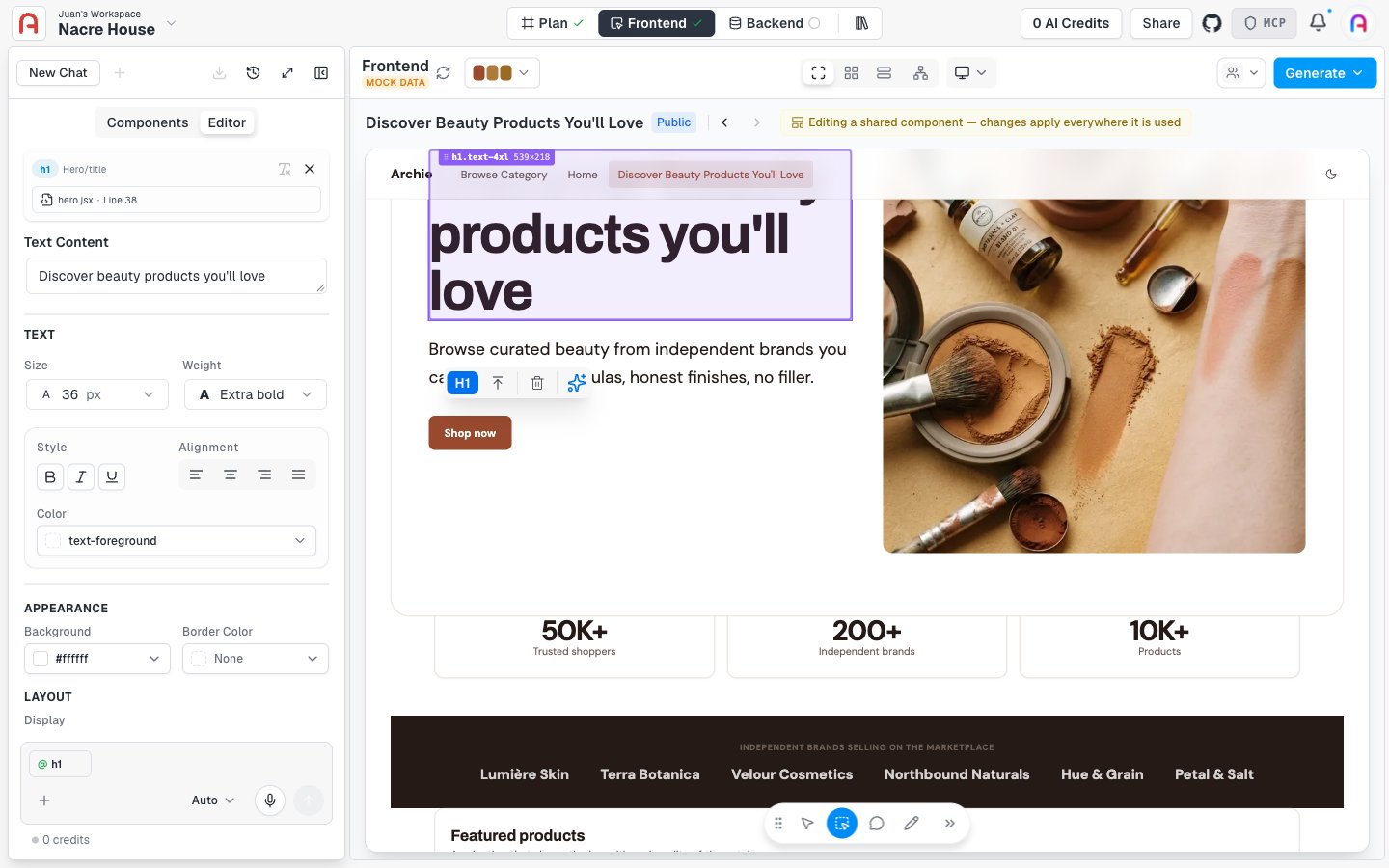
The visual editor is point-and-click. Click an element in the live preview and the inspector shows its properties — text, color, padding, position — with changes applied live. Use it for layout tweaks, copy edits, image swaps, and styling. For precise visual requests, mark up the preview with [Draw mode](/docs/features/frontend/draw-mode) and send your marks to chat. See [Visual editor](/docs/features/frontend/visual-editor).
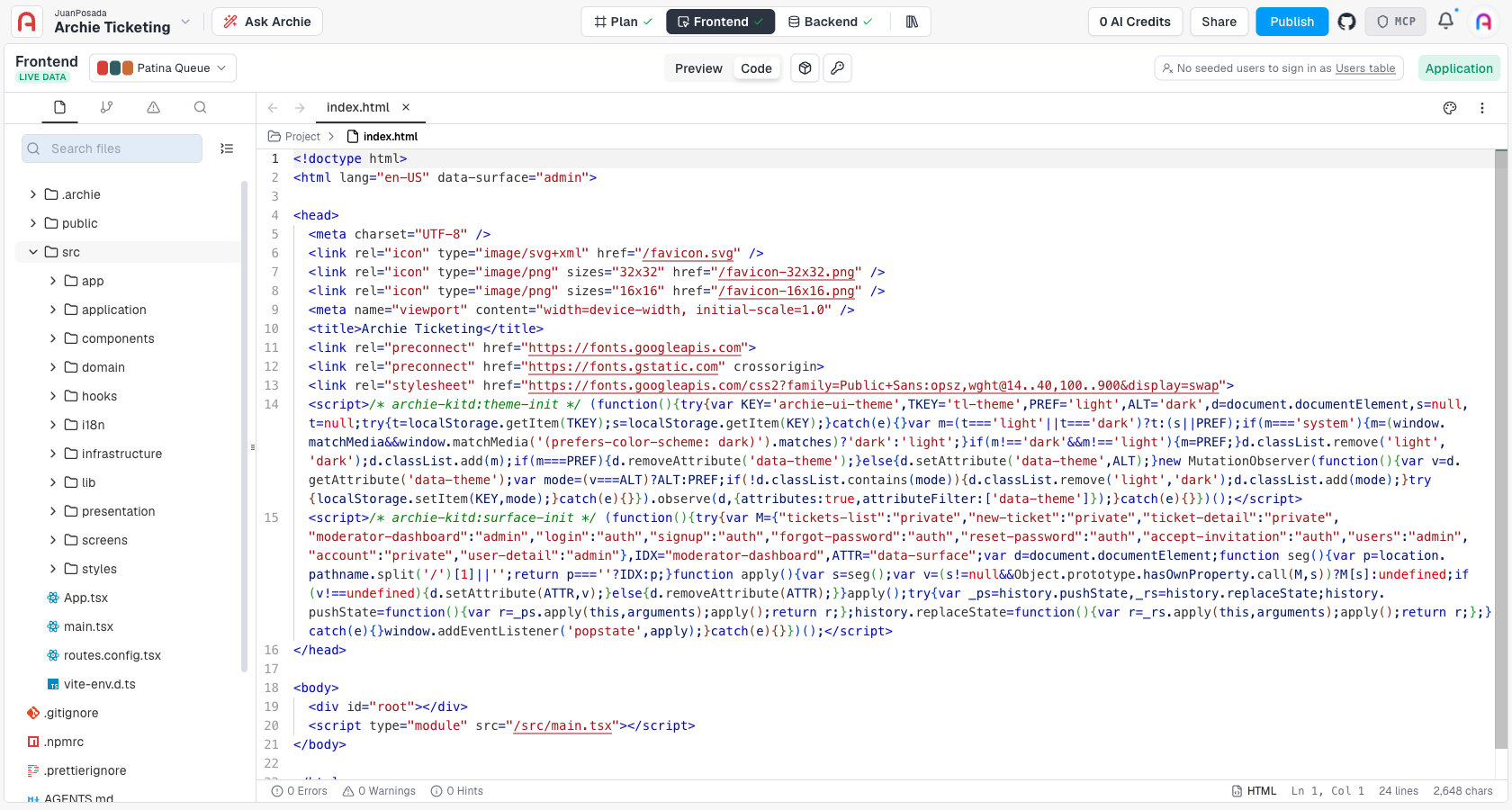
 Edit code directly in the built-in [code editor](/docs/features/frontend/code-editor), or connect GitHub for two-way sync: Archie pushes generated code to a repository you choose and pulls back commits made outside Archie, so you can work in Cursor, Claude Code, or any editor. See [Organization integrations](/docs/introduction/organizations/organization-integrations).
The activity feed shows every action across your project — builds, deployments, plan edits, and comments. Backend [Logs](/docs/features/backend/logs), with live streaming across services and environments, are coming soon.
Generated frontends follow a predictable `src/` structure: `app/` for routes, `components/` for reusable UI, `domain/` and `infrastructure/` for business logic and data access, plus `hooks/`, `lib/`, and `styles/`. The data model lives on the backend, which exposes it through GraphQL and REST automatically. See the [Backend overview](/docs/features/backend/overview).
Edit code directly in the built-in [code editor](/docs/features/frontend/code-editor), or connect GitHub for two-way sync: Archie pushes generated code to a repository you choose and pulls back commits made outside Archie, so you can work in Cursor, Claude Code, or any editor. See [Organization integrations](/docs/introduction/organizations/organization-integrations).
The activity feed shows every action across your project — builds, deployments, plan edits, and comments. Backend [Logs](/docs/features/backend/logs), with live streaming across services and environments, are coming soon.
Generated frontends follow a predictable `src/` structure: `app/` for routes, `components/` for reusable UI, `domain/` and `infrastructure/` for business logic and data access, plus `hooks/`, `lib/`, and `styles/`. The data model lives on the backend, which exposes it through GraphQL and REST automatically. See the [Backend overview](/docs/features/backend/overview).
 ## Explore the docs
The definition of your app: modules, user types, services, and integrations.
UI architecture, the prototype, the generated React app, and the editors you use after the build.
Archie Core: data model, auto-generated APIs, auth, roles, environments, and integrations.
Upload and manage the images, videos, and documents your app uses, and reference them anywhere.
### Common tasks
Add tables, fields, and relationships. APIs regenerate automatically.
Stripe, SendGrid, Twilio, Slack, Shopify, or build your own.
Branch development and staging environments, compare schemas, and merge changes to production.
Authenticate external clients with scoped, per-environment API keys.
## Who Archie is for
Archie is for founders, product teams, designers, and developers who want to move fast without ending up with code they have to throw away. You don't need to know how to code — you describe the app and Archie builds it. If you do write code, you get full access to the code, the data model, and the infrastructure.
Start on the **Free** plan with no credit card. It covers plan and prototype generation. See [Plans and credits](/docs/introduction/getting-started/plans-and-credits) for what each plan includes.
**Coming soon: Specifications.** A detailed layer between the plan and the code — functional, visual, and technical design documents that the build agents read before writing anything. When it ships, the flow becomes prompt → plan → specifications → code.
## Need help?
Browse the [FAQ](/docs/faq/getting-started), join the [Discord community](/docs/introduction/community-support/community), or [contact support](/docs/introduction/community-support/contacting-support).
## Explore the docs
The definition of your app: modules, user types, services, and integrations.
UI architecture, the prototype, the generated React app, and the editors you use after the build.
Archie Core: data model, auto-generated APIs, auth, roles, environments, and integrations.
Upload and manage the images, videos, and documents your app uses, and reference them anywhere.
### Common tasks
Add tables, fields, and relationships. APIs regenerate automatically.
Stripe, SendGrid, Twilio, Slack, Shopify, or build your own.
Branch development and staging environments, compare schemas, and merge changes to production.
Authenticate external clients with scoped, per-environment API keys.
## Who Archie is for
Archie is for founders, product teams, designers, and developers who want to move fast without ending up with code they have to throw away. You don't need to know how to code — you describe the app and Archie builds it. If you do write code, you get full access to the code, the data model, and the infrastructure.
Start on the **Free** plan with no credit card. It covers plan and prototype generation. See [Plans and credits](/docs/introduction/getting-started/plans-and-credits) for what each plan includes.
**Coming soon: Specifications.** A detailed layer between the plan and the code — functional, visual, and technical design documents that the build agents read before writing anything. When it ships, the flow becomes prompt → plan → specifications → code.
## Need help?
Browse the [FAQ](/docs/faq/getting-started), join the [Discord community](/docs/introduction/community-support/community), or [contact support](/docs/introduction/community-support/contacting-support).